
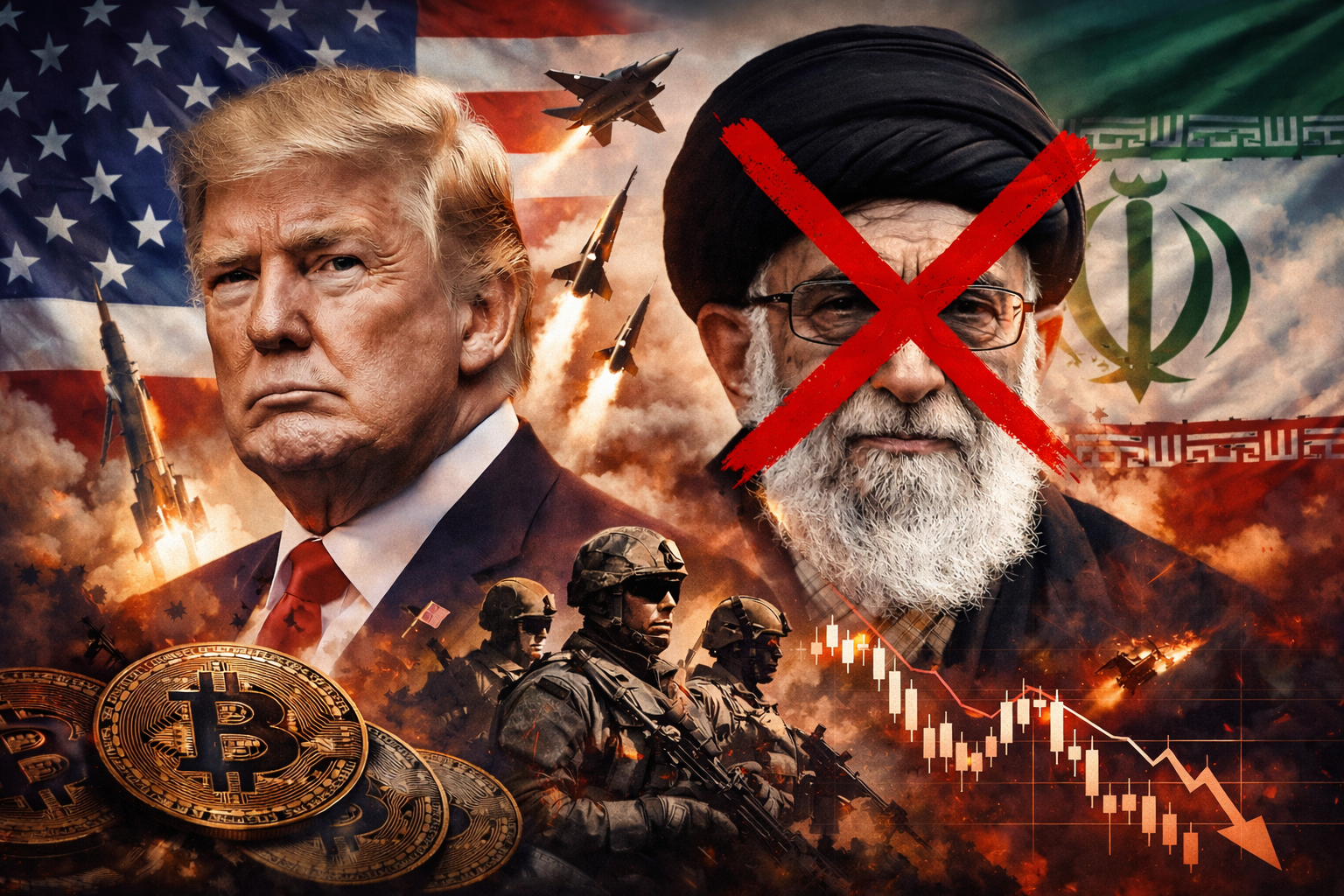
Iran War: What does it mean for the crypto market?
The military conflict between the U.S., Israel, and Iran has escalated into open warfare. Strikes in Tehran, southern Lebanon, and around U.S. bases in the region.
What does this mean for the crypto market?
Because crypto is the only market that never closes.
The first reaction: Crypto as a “pressure valve”
While stock markets were closed over the weekend, crypto took the first hit.
Within minutes:
- Bitcoin dropped to around $63,000
- Over $500M in liquidations
- Tens of billions wiped from total market cap
- ETH down ~5%
- $100M+ in long liquidations in 15 minutes
Important clarification:
This is not a fundamental collapse.
Crypto is simply the only liquid risk asset trading 24/7. When a shock hits on a Saturday night, people sell what they can.
That’s why we often see an initial dump that later stabilizes once traditional markets open.
The key level for Bitcoin remains the ~$60K zone. If it holds, the structure stays relatively intact. If it breaks, $55K–$58K becomes a realistic scenario.
Why is this conflict different?
Because this time, it all comes down to oil.
Iran controls the Strait of Hormuz, a route that carries roughly 20% of global oil shipments.
If there is a real disruption:
War → Oil spike → Higher inflation → Pressure on the economy → Recession risk.
This is no longer just geopolitical noise.
This is a macro factor.
Historically, markets often recover after a war begins.

But very few past conflicts have directly threatened global energy supply at this scale.
And that’s where the real test begins.
Bitcoin: risk asset or hedge?
In the short term, Bitcoin behaves like a risk-on asset.
Fear → it drops.
But in the medium term, the scenario gets more interesting.
Bull case:
- Oil spike → inflation pressure
- The Fed forced into rate cuts
- More liquidity
- Confidence in fiat currencies gets shaken
In environments like this, Bitcoin has historically performed well.
A telling example is Iran itself.
According to Chainalysis data, the country’s crypto ecosystem surpassed $7.78B in on-chain volume in 2025, with activity strongly correlating with domestic stress and rial depreciation.
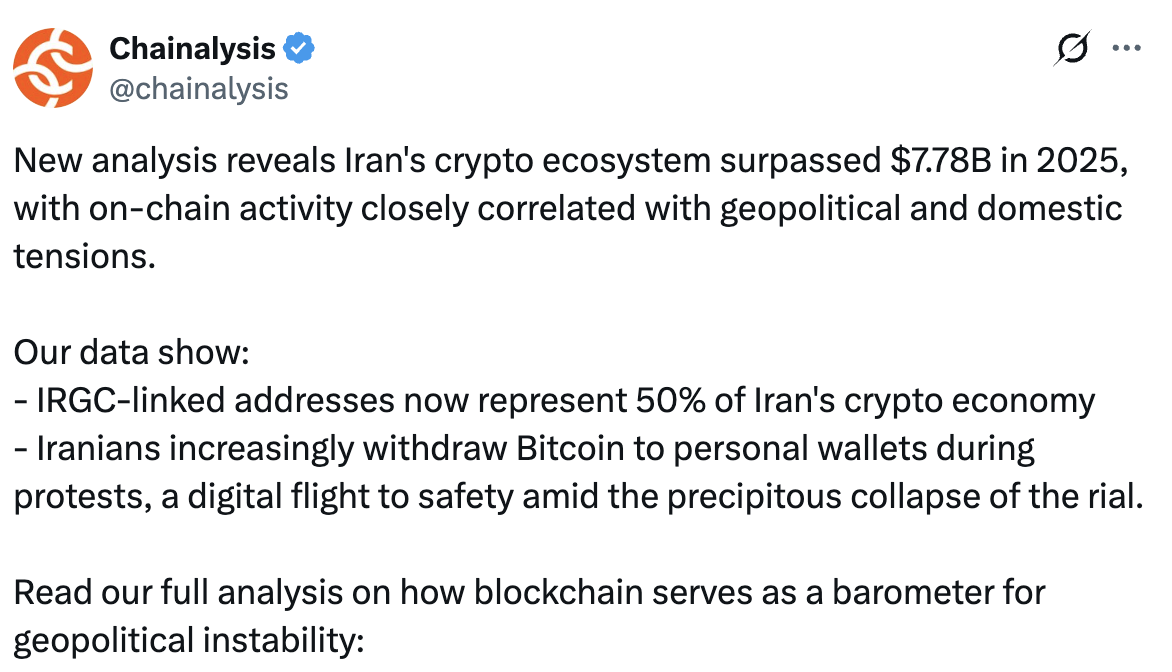

When the currency collapses, people look for an exit.
And increasingly, that exit is Bitcoin.
Bear case:
- If the conflict drags on and oil stays above $100:
- Liquidity dries up
- Markets move into “cash is king” mode
- Everything risky gets sold
In a true recession, Bitcoin has no immunity.
Today, when traditional markets open, that will be the real test.
And gold?
Gold has already reacted.
A new all-time high.
Strong inflows.
Banks projecting $6,000/oz within 12 months.
In the short term, gold is winning the “safe haven” battle.
But if the war triggers another wave of money printing, the picture can flip.
What does this mean for altcoins?
Altcoins take a harder hit during events like this.
The reason is simple:
When risk rises, capital flows back to:
- Cash
- Gold
- Bitcoin
Only after stabilization do we see rotation back into higher-risk assets.
If we see BTC holding key levels and oil stabilizing, altcoins could surprise to the upside.
But if BTC breaks below $60K, the odds of a deeper correction in altcoins rise significantly.
The only thing that matters
Not the S&P.
Not the ETFs.
Not even the liquidations.
Oil.
- Below $90 → likely a manageable scenario
- Sustained above $100 → risk of a rough 2026
Everything else is a second-order effect.
Conclusion
The crypto market reacts first.
But it doesn’t always react correctly.
Short term – volatility.
Medium term – inflation risk that could work in Bitcoin’s favor.
Long term – it all depends on whether the conflict actually disrupts the global energy system.
Watch:
- The price of oil
- The Fed’s reaction
- BTC behavior around $60K
The situation is evolving literally hour by hour.
If you want analysis like this in real time, follow the Altcoins.bg blog.