
Did you receive a letter from the National Revenue Agency regarding foreign income? What does this mean for crypto investors...
In recent weeks, individuals have been receiving notification letters from the Bulgarian National Revenue Agency (NRA) regarding foreign income and information obtained through the automatic exchange of information between tax authorities.
For people who invest in or trade crypto-assets, such a letter raises several logical questions: has a violation been identified, how is taxable income calculated, and when could an obligation to register for VAT arise?
It is important to clarify that the letter is not aimed solely at holders of crypto-assets. It covers various types of foreign income and does not, in itself, mean that a violation has been identified or that a tax audit has been initiated.
What does the NRA letter actually say?
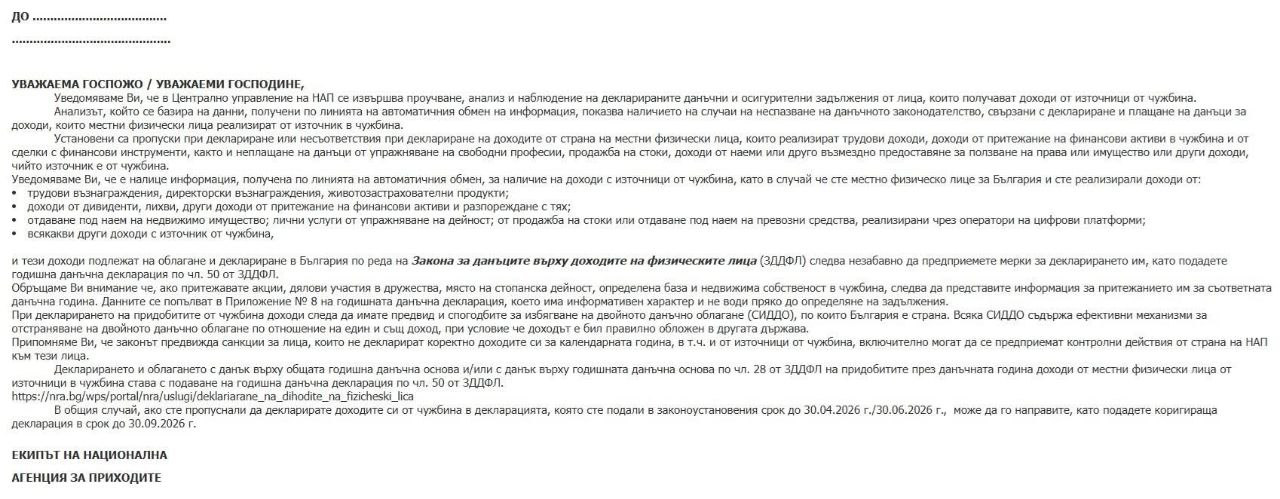
The NRA analyses the declared tax liabilities of individuals who have received income from abroad. The categories listed include employment and directors’ remuneration, dividends, interest, income from financial assets and instruments, rental income, services and others.
The purpose of the notification is to encourage recipients to check whether all income subject to taxation in Bulgaria has been correctly included in their annual tax return.
This also applies to crypto investors. Information about crypto-asset transactions is increasingly reaching tax authorities through regulated service providers, banks and international data exchange. It is therefore important to keep detailed records of purchases, sales and exchanges.
How is income from crypto-assets calculated?
For individuals, income from the sale or exchange of crypto-assets is generally treated under the rules governing income from the transfer of rights or property under the Bulgarian Personal Income Tax Act.
Taxable income is not determined based on the total value of purchases or sales made during the year. Instead, the result from realised transactions is calculated – the difference between the sale price and the acquisition price. Profits and losses are aggregated, after which the law provides for a deduction of 10% in recognised expenses, and a 10% tax is applied to the remaining profit.
For example, if the same capital has been used repeatedly and your statement shows purchases totalling €195,000 and sales totalling €200,000, this does not mean that you have taxable income of €200,000. For tax purposes, the realised result from the transactions is calculated.
According to the NRA, this income is declared in Appendix No. 5 of the annual tax return.
View the NRA’s official information on income from crypto-assets
If you are unable to handle the calculations yourself, it may be appropriate to use the services of a professional who can review your individual case and correctly calculate the tax due.
This also raises another question... If I hold large positions or have generated a high trading volume, do I need to register for VAT?
Does buying more than €51,130 worth of Bitcoin require VAT registration?
No. The size of the purchase or the value of your portfolio does not automatically result in an obligation to register for VAT.
The €51,130 threshold in 2026 is not a limit on personal investments in crypto-assets. It relates to the annual turnover of a person carrying out an independent economic activity.
If an individual buys €52,000 worth of BTC and holds it as a personal investment, the size of that purchase alone is not grounds for mandatory VAT registration.
What if you sell a crypto-asset for more than €51,130?
Here too, no automatic conclusion can be drawn based solely on the amount. If, for example, you buy a crypto-asset for €52,000 and sell it for €80,000, two separate questions need to be considered:
- Income tax: if a taxable profit has been realised, it is calculated and declared in accordance with the rules of the Bulgarian Personal Income Tax Act.
- VAT: the sale price alone does not prove that the person is carrying out an independent economic activity. Before considering the VAT registration threshold, the nature of the activity must first be assessed.
Therefore, a large purchase or sale involving a personal investment does not automatically create an obligation to register for VAT.
Generally speaking, the size of your positions does not mean that you, as an individual, are automatically subject to VAT registration. It must first be established whether you are managing personal assets or carrying out an active commercial activity.
When can active trading change the tax treatment?
When transactions are frequent, systematic, organised and carried out on a significant scale, it should be assessed whether the activity goes beyond the ordinary management of personal assets.
The NRA states that if an individual acts as a trader within the meaning of the Bulgarian Commerce Act, the standard tax regime for income from the sale or exchange of crypto-assets does not apply. What matters is the activity actually carried out, not merely whether the person is registered as a sole trader.
There is no universal number of transactions after which an investor automatically becomes a trader. Nor is there a specific trading volume that, by itself, automatically results in VAT registration. The assessment depends on the frequency, systematic nature, organisation, scale and manner in which the activity is carried out.
Does €200,000 in trading volume mean €200,000 in turnover for VAT purposes?
No such conclusion can be drawn solely from a platform statement.
It must first be established whether the person is carrying out an independent economic activity. Only then can it be analysed which transactions form part of the annual turnover for VAT purposes and how their taxable amount should be determined.
Total trading volume, taxable income under the Bulgarian Personal Income Tax Act and turnover for VAT registration purposes are different concepts and are calculated according to different rules.
If you recognise your own situation in this article and believe that you may have income that needs to be declared, here is what you can do:
What should you do if you failed to declare income for 2025?
If you have already submitted your annual tax return but later discover an error or omitted income, you can submit a new return.
After the regular filing deadline has passed, the NRA allows a one-time correction until 30 September 2026. If the correction results in an additional tax liability, interest may be charged on the amount that was not paid within the original deadline.
View the NRA’s official information on correcting an annual tax return
Key takeaways
- A notification letter from the NRA does not automatically mean that a violation has been identified or that a tax audit has been initiated.
- For crypto-assets, tax is based on the realised result from transactions, not the total volume of purchases and sales.
- Buying more than €51,130 worth of Bitcoin or another crypto-asset does not, by itself, require VAT registration.
- A single sale above this threshold does not automatically create a VAT registration obligation either.
- In cases of systematic and organised trading, the tax treatment may be different and an individual assessment is required.
- Omissions in the 2025 annual income tax return can be corrected once by 30 September 2026.
Frequently asked questions
I hold more than €51,130 worth of crypto-assets. Do I need to register for VAT?
- Not solely because of the value of your portfolio. The VAT registration threshold is not a threshold for the size of personal investments.
I sold Bitcoin for €80,000. Does this automatically mean that I owe VAT?
- No. It must first be established whether you are carrying out an independent economic activity. Separately, any realised profit and its taxation under the Bulgarian Personal Income Tax Act must be assessed.
If I make a large number of transactions, am I automatically considered a trader?
- There is no universal number of transactions after which this happens automatically. The specific facts, systematic nature, scale and manner in which the activity is carried out are taken into account.
Does receiving a letter from the NRA mean that I am being audited?
- Not necessarily. The letter invites the recipient to review the information they have declared and correct it where necessary. In itself, it does not constitute a finding that a tax liability has been established.