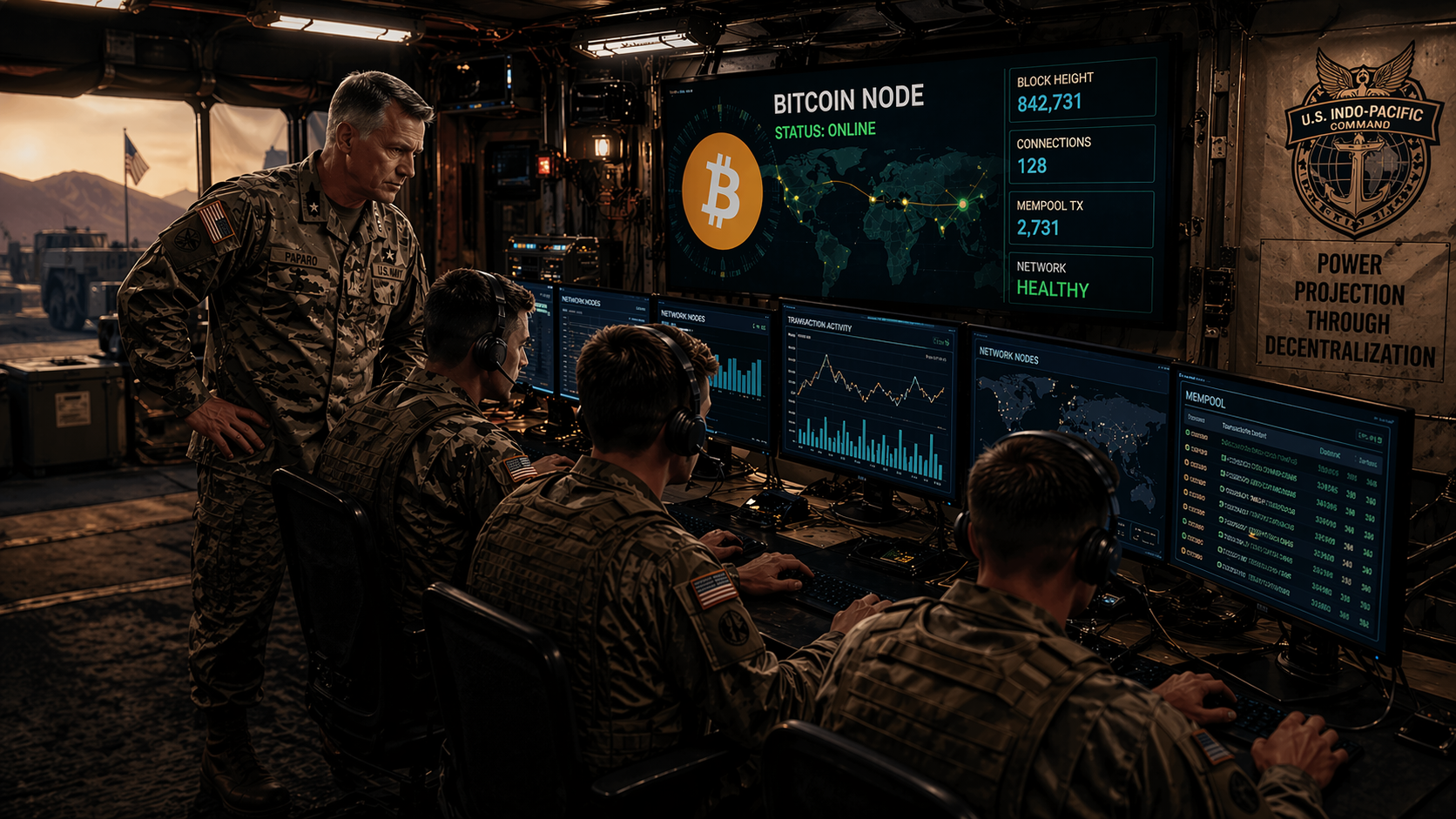
The US military… is stepping directly into the Bitcoin network.
No, not to buy it.
Not to mine it.
But to test it.
And this changes the way we should look at crypto.
The military is already inside Bitcoin
Admiral Samuel Paparo, who leads U.S. Indo-Pacific Command, confirmed something that would have sounded absurd just a few years ago:
The US military is currently running its own Bitcoin node.
But let’s make one thing clear.
This is not mining.
This is monitoring, testing, and… strategy.
What are they actually doing?
A Bitcoin node is simply a computer that:
- stores the entire history of the network
- validates transactions
- participates in peer-to-peer communication
In other words:
- It is a way to “see” the network from the inside.
- Without intermediaries.
- Without trusting third parties.
The military uses this node to:
- monitor activity on the network
- test security
- simulate scenarios for protecting systems
Sounds like cybersecurity, right?
Yes.
But not only.
The real reason: China
China is the main geopolitical rival right now.
And according to Paparo, Bitcoin has:
“incredible potential” as a tool for "power projection"
This is no longer just a technology topic.
This is geopolitics.
Wait… wasn’t Bitcoin supposed to be anti-government?
This is where it gets interesting.
Bitcoin was created to be:
- decentralized
- resistant to control
- independent from states
And yet…
One of the most powerful militaries in the world decides to participate in it.
Not to stop it.
Not to ban it.
But to understand it.
Is this a threat?
The short answer: no.
There are tens of thousands of nodes on the network.
One military node:
- controls nothing
- cannot change the rules
- cannot manipulate the network
Bitcoin remains exactly what it is:
👉 a system without central control
So why does it matter?
Because it shows something much bigger.
Years ago:
- Bitcoin was a niche technology
- crypto was called a “pyramid scheme”
Today:
- states monitor it
- institutions use it
- militaries test it
That is evolution.
What does this mean for you?
If even the US military sees Bitcoin as a strategic resource…
maybe it’s not a bad idea to understand how it works.
Not as speculation.
But as technology.
If you don’t want to miss future articles and analyses, subscribe to our blog – this way you’ll receive them directly in your inbox.