
Crypto scams are now an industry. 2025 proved it.
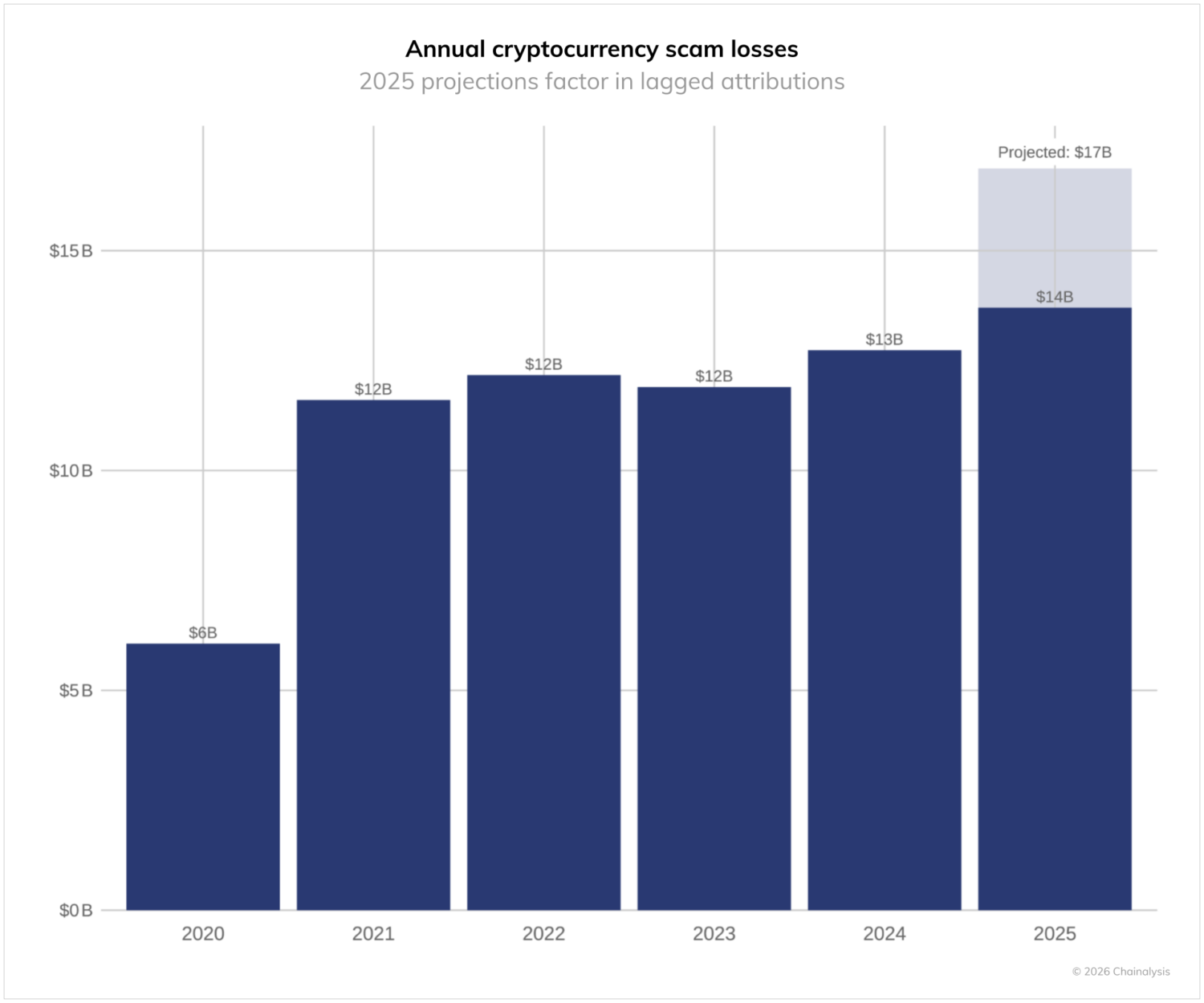
2025 made one thing crystal clear: crypto fraud is no longer a set of “isolated cases”, but a well-organized industry. According to the latest Chainalysis report, illicit addresses have received at least $14B on-chain so far, with the real figure likely to exceed $17B once additional addresses are identified.
This is not just growth. It is a fundamental shift in how scammers operate.
From “schemes” to industrial-scale fraud
The biggest jump in 2025 comes from impersonation scams – fraud where criminals pose as government agencies, banks, exchanges, or legitimate companies.
- Up 1,400% year-over-year
- The average payment amount has increased by over 600%
- Victims are no longer “random”, but carefully selected
Scammers do not rely on luck. They rely on data, psychology, and technology.
How AI changed the game
Artificial intelligence is now a core tool in the scammers’ arsenal.
Operations with on-chain links to AI service providers:
- Generate 4.5x higher revenue
- Average $3.2M per operation, versus $719,000 for others
- Are 9x more transactionally active, pointing to scale and automation
Fake messages, deepfake voices, realistic emails, entire fake platforms. All of it can now be produced quickly, cheaply, and at massive scale.
“Lighthouse” and the fraud business model
One of the most illustrative examples is the Lighthouse operation – a phishing-as-a-service model.
- Ready-made scam kits for $20–50
- A total of $1.5M in revenue over 3 years
- Anyone can become a scammer, with no technical skills
It is a SaaS model, but for crime.
Record strikes by authorities
Despite all of this, 2025 also brought the biggest crackdowns on crypto crime to date:
- The UK seized 61,000 BTC (around £5B) in the Jian Wen case
- The U.S. targeted the Prince Group, with over $15B in assets in sight and 146 sanctions
This shows that blockchain is not an anonymous safe haven, but an environment with increasingly effective enforcement.
On average, victims are paying more
Another alarming signal:
- The average payment to scams jumped by 253%
- From $782 in 2024 to $2,764 in 2025
This points to better targeting, higher trust-building, and bigger losses.
It is important to note that fighting crypto fraud is not a new topic for us. Altcoins.bg has been actively working against these schemes for years, including through our partnership with AML Bot. Thanks to this collaboration, we now have the first successful case in Bulgaria with funds actually recovered after a crypto scam.
If you want to dive deeper, you can read more here:
How AMLBot and Altcoins.bg join forces against crypto scams
The first successful case in Bulgaria with funds recovered after a crypto scam
What this means for you
The truth is simple and unpleasant:
- More than half of all cryptocurrencies created after 2021 have already failed
- A large share of them – specifically in 2025
To avoid a painful lesson, stick to legitimate, proven platforms like Altcoins.bg. Buy and exchange crypto only through trusted services.
Do not chase “schemes”. Do not chase quick riches. In crypto, that almost always ends with a total loss.
Do not “invest” in the “new” Bitcoin, Ethereum, or Solana.
Invest smart.
And remember the first rule: first we do not lose money, then we think about making it.
Helpful resources on the topic
If you want to better understand how crypto scams work and how to protect yourself:
- 📺 Watch our crypto scam webinar on YouTube
- 📖 Read our detailed guide on the most common investment scams
These resources are not just informative – they can be crucial.