
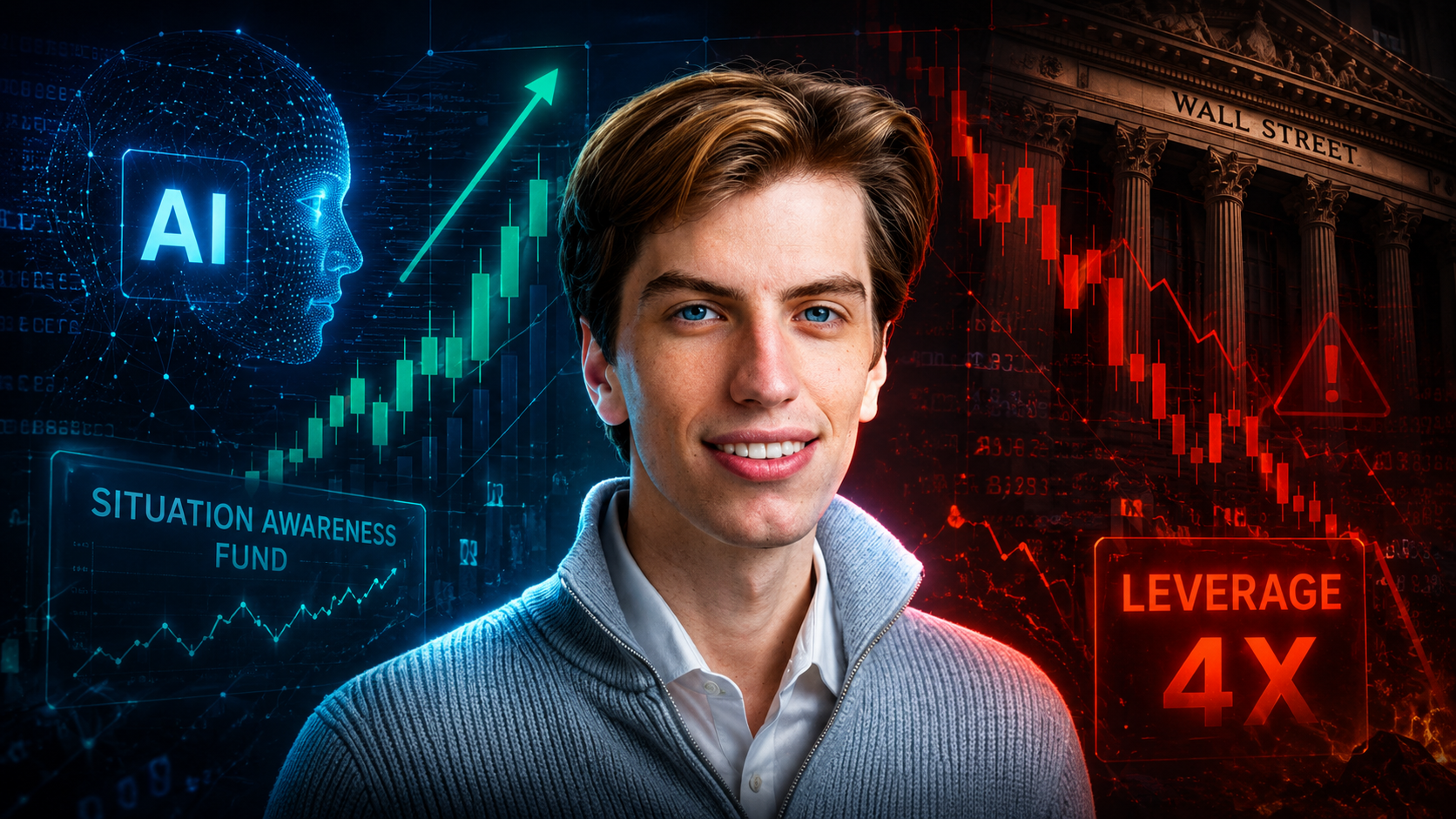
From $45 billion to a margin call: the story that serves as a reminder of why leverage can be dangerous
Over the past few days, one story has been spreading through financial circles at remarkable speed.
The story of 24-year-old Leopold Aschenbrenner and his fund, Situation Awareness.
Whether all the details surrounding the case will ultimately be fully confirmed remains to be seen. Regardless, the story carries an extremely important lesson for every investor – especially when it comes to leveraged trading.
From AI to Wall Street
Leopold Aschenbrenner became one of the most talked-about names in the world of artificial intelligence after working at OpenAI and publishing his extensive analysis, Situational Awareness, focused on the future development of the AI industry.
The report quickly attracted the attention of some of the biggest investors in Silicon Valley, who entrusted him with hundreds of millions of dollars to establish his own investment fund.
Instead of investing in the best-known AI companies, Aschenbrenner focused on chip manufacturers, memory producers, and the infrastructure behind artificial intelligence. At the same time, he also opened short positions against some traditional software companies.
At first, the strategy appeared brilliant.
Within just a few months, the fund reportedly generated impressive returns, while substantial institutional capital began flowing into it.
Where Did Things Go Wrong?
The investment thesis itself did not appear to be the biggest problem.
The issue was that, according to the information being circulated, the fund began using significant leverage.
In simple terms, this means that in addition to its own capital, the fund also used large amounts of borrowed money, allowing potential profits to be multiplied.
But the same applies to losses.
A market move against the position is enough to trigger a chain reaction.
That is exactly what reportedly happened.
Following a correction in some AI infrastructure companies and market movements against the short positions, the fund came under pressure to provide additional collateral.
This was followed by so-called margin calls.
When an investor is unable to provide the required funds, assets begin to be sold forcibly.
At that point, the losses no longer depend on whether you still believe in your investment thesis.
The market simply liquidates the positions.
The Most Important Lesson
This story once again highlights something financial markets have demonstrated for decades.
The most intelligent investor does not necessarily win.
Nor does the person with the best forecast.
Often, the one who survives is the one who manages risk most effectively.
Leverage can multiply returns, but it can destroy capital just as quickly.
Especially during periods of extreme volatility, such as those seen in both traditional and crypto markets.
Why Is This Important for Crypto Investors?
Crypto assets are inherently far more volatile than traditional financial markets.
Adding high leverage to that volatility increases the risk even further.
That is why, in recent years, we have witnessed billions of dollars in liquidations taking place within just a few hours.
Many investors lose money not because they selected the "wrong" asset, but because they used excessive leverage.
Our Philosophy
At Altcoins.bg, we have always placed security ahead of the pursuit of maximum risk.
That is why we currently do not offer leveraged trading.
Our focus is on the actual purchase and sale of crypto assets, rather than products that can increase both potential returns and the risk of rapidly losing capital.
Sometimes the best decision is not the one that promises the highest return.
It is the one that helps investors remain in the market long enough to make well-informed decisions.
The story of Aschenbrenner, regardless of what new details may emerge, is another reminder that risk management will always be more important than pursuing the maximum possible return.